

Section 179
Tax Deduction
Time left to qualify for the 2026 Section 179 deduction:
vehicle bought and ready for business use by December 31
Attention Metro Detroit Business Owners!
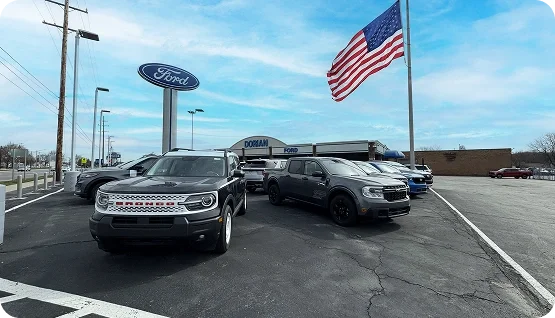
A New Truck or SUV might be a great way to invest in your business and save on your taxes!
Section 179 Tax Deduction of the IRS tax code may allow your business to deduct, for the current tax year, the full purchase price of qualifying equipment or vehicles purchased or financed and placed in service during the tax year. Whether you buy or finance a new or used car, truck, SUV or van for your business, you may be able to take advantage of the incentives from the government to grow your business.
Qualify for 2026 Tax Deduction
To qualify for the deduction for tax year 2026, your Ford vehicle must be purchased or financed, and it must be put into service (ready and available to use) between January 1, 2026 and December 31, 2026 (for a business on a calendar tax year). In order for your Ford vehicle to qualify, it must be used more than 50% for business, based on mileage, in the first year it is placed in service. Therefore, if you choose to use it for both personal and business use, the cost eligible for the deduction would be the percentage used for business.
Before you count on Section 179 for a vehicle, go through these five points.
- 1. It has to be a purchase.
- Section 179 property must be acquired by purchase. Property received as a gift or inheritance does not count, and property bought from a related person (for example, a spouse, ancestor or lineal descendant) or a member of the same controlled group is not treated as acquired by purchase.
- 2. Business use has to stay above half.
- If business use falls to half or less in a later year during the vehicle's recovery period, you may have to add part of the deduction back to income.
- 3. In service means ready to use.
- Property is in service when it is ready and available for its specific use, even if you are not using it yet.
- 4. Financing still means ownership.
- The IRS treats you as the owner of property even if it is subject to a debt. If you plan to finance, look over our current Ford finance offers.
- 5. Leasing works differently.
- A business that leases a vehicle generally cannot depreciate its cost, because the business does not own it.
Tax Treatment by Vehicle Type
The IRS sets these limits by a vehicle's weight rating and body. Bonus depreciation is a separate 100% first-year allowance for qualified property acquired and placed in service after January 19, 2025.
| Applies To | Tax Treatment | What the IRS Says |
|---|---|---|
|
Trucks and Vans That Meet an IRS Exception (Over 6,000 lbs. gross vehicle weight rating (GVWR)) |
Up to 100% of the purchase cost in the first year* | The SUV cap (up to $32,000) does not apply to a vehicle: More than nine seats behind the driver's. Designed to seat more than nine passengers behind the driver's seat. A cargo area at least 6 feet long, not readily accessible from the cab. Equipped with a cargo area (either open or enclosed by a cap) of at least 6 feet in interior length that is not readily accessible from the passenger compartment; or enclosed cargo body with no seats behind the driver. That has an integral enclosure fully enclosing the driver compartment and load carrying device, does not have seating rearward of the driver's seat, and has no body section protruding more than 30 inches ahead of the leading edge of the windshield. |
| Passenger Trucks/Vans and SUVs (Over 6,000 and not over 14,000 lbs. GVWR) | Up to $32,000 (the SUV cap) of the purchase cost under Section 179* | “Any 4-wheeled vehicle primarily designed or used to carry passengers over public streets, roads, or highways that is rated at more than 6,000 pounds gross vehicle weight and not more than 14,000 pounds gross vehicle weight.” |
| Trucks and Vans (6,000 lbs. GVWR or less) | Up to $20,300 in the first year with bonus depreciation, or up to $12,300 without* | A passenger automobile includes trucks and vans rated at “6,000 pounds or less of gross vehicle weight.” |
| Passenger Automobiles (6,000 lbs. or less unloaded gross vehicle weight) | Up to $20,300 in the first year with bonus depreciation, or up to $12,300 without* | “Any four-wheeled vehicle made primarily for use on public streets, roads, and highways and rated at 6,000 pounds or less of unloaded gross vehicle weight.” |
*2026 IRS figures: the Section 179 and SUV caps are for tax years beginning in 2026, and the passenger automobile limits are for vehicles placed in service during calendar year 2026. A rating over 6,000 pounds does not settle the question on its own. The SUV cap limits only the Section 179 amount.

2026 Ford Trucks, Vans and SUVs
by Weight Rating (GVWR)
This table lists Ford's 2026 gross vehicle weight ratings. Bed length matters because of the IRS cargo-area exception.
| 2026 Ford | GVWR (Ford Rating) | Bed Length Inside, at the Floor |
|---|---|---|
| F-150 (except the Raptor R) | 6,220 to 7,400 lb | 5.5-ft box 67.1 in (67.2 in on the F-150 Raptor); 6.5-ft box 78.9 in; 8-ft box 97.6 in |
| Super Duty F-250, F-350 and F-450 pickups | 10,000 to 14,000 lb | 6-3/4-ft box 81.9 in; 8-ft box 98.1 in |
| Ranger | 6,050 to 6,790 lb | 59.6 in |
| Maverick | 4,970 to 5,330 lb | - |
| Bronco 2-Door | 5,540 to 5,740 lb | No pickup bed |
| Bronco 4-Door | 5,920 to 6,250 lb, depending on configuration | No pickup bed |
| Bronco Raptor | 6,850 lb | No pickup bed |
| Transit Cargo Van and Transit Passenger Van | Over 6,000 lb on every 2026 Transit van | No pickup bed |
The 5.5-ft F-150 box and the Ranger bed are shorter than 72 inches; the 6.5-ft and 8-ft F-150 boxes and both Super Duty boxes are longer. Length is only one part of that test.
Whether an SUV such as a Bronco counts as a truck (measured on GVWR) or not (measured on unloaded weight) is a question to settle with your tax advisor.
Every vehicle's GVWR is printed on its Safety Compliance Certification Label on the driver's door edge or door pillar. For an Expedition, Explorer, Bronco Sport or F-150 Raptor R, use the rating on that vehicle's label, or ask our sales team about a specific vehicle.
Seating exception: The SUV cap does not apply to a vehicle designed to seat more than nine passengers behind the driver's seat. Ford builds the Transit Passenger Van in a 12-passenger version with 10 seats behind the first row (behind the driver's seat, in the IRS wording) and a 15-passenger version with 13. Ford also builds a 2-seat version, so the seat count depends on the exact van.
Browse new F-150 trucks, Ranger pickups or Maverick pickups. For Super Duty pickups and Transit vans, start with our commercial Ford trucks and vans.
Section 179 Tax Deduction Limits
Section 179 does come with limits: there are caps to the total amount written off ($2,560,000 for tax years beginning in 2026). All businesses that purchase or finance a new or used business vehicle and put it into service during tax year 2026 and use it more than 50% for business may qualify for the Section 179 Deduction.
The phase-out threshold is $4,090,000 for tax years beginning in 2026. The phase-out works dollar for dollar: once the cost of Section 179 property a business places in service during the year passes the threshold, the maximum deduction shrinks by the amount over it. The deduction also cannot be more than the taxable income from any active trade or business for the year; any amount over that can carry to the next year. For a passenger automobile, the IRS limits the Section 179 deduction and depreciation together, up to $20,300 for the first year with bonus depreciation or up to $12,300 without.
Buying From Dorian Ford
Dorian Direct lets you select a vehicle, personalize your payment and apply for credit online, and we can deliver to your home or office. Business buyers get the same no-pressure, straight talk about pricing we give everyone.
If you are comparing work trucks, start with our guide to choosing a Ford work truck.
If a used vehicle fits your business, our Ford Blue Advantage certified vehicles come with a complimentary CARFAX and a 14-day / 1,000-mile money-back guarantee. See how certification works or shop our certified pre-owned vehicles.
Questions about a vehicle for your business? Contact our sales team.


A Note on Taxes
This is general information about federal tax rules, not tax advice. Your Michigan state return is a separate question to take to your tax professional.
Frequently Asked Questions
The requirements the IRS lists for Section 179 include buying the vehicle and using it more than 50% for business; being new is not on that list. Bonus depreciation also covers "new property or certain used property." Whether a particular used or certified Ford fits your return is a question for your tax professional.
A Bronco used more than 50% for business can qualify; the exact Bronco decides which IRS limit applies. The 2026 Bronco 2-Door is rated 5,540 to 5,740 lb GVWR. A vehicle rated at 6,000 pounds or less GVWR is also 6,000 pounds or less unloaded, so on either IRS weight test the 2-Door falls under the passenger automobile limits: up to $20,300 in the first year with bonus depreciation, or up to $12,300 without. The 4-Door is rated 5,920 to 6,250 lb; its configurations rated under 6,000 lb fall under the same limits.
Within the 4-Door range, a 2.3L Big Bend is rated 5,920 lb, or 6,110 lb with the Black Diamond package and a manual transmission. A 2.7L V6 Badlands is rated 6,250 lb.
For a Bronco rated over 6,000 lb, your tax professional applies the IRS vehicle tests. Browse new Ford Bronco inventory.
The 6,000-pound line shows up in two IRS definitions. A passenger automobile is rated at 6,000 pounds or less, using unloaded weight except for trucks and vans, which use gross vehicle weight. Its first-year limits are up to $20,300 with bonus depreciation or up to $12,300 without. The SUV cap (up to $32,000) covers four-wheeled passenger vehicles rated above 6,000 and up to 14,000 pounds gross vehicle weight. A GVWR over 6,000 pounds does not, by itself, decide which limit applies.
Generally, no, not for the business that leases it.
Yes. A business that buys with financing still owns the vehicle.
For a business on a calendar tax year, the vehicle must be placed in service, not only purchased, by December 31, 2026.
