

2026 Ford E-Transit® in Southeast Michigan
The 2026 Ford E-Transit® is Ford's all-electric commercial van, offered in three body styles (Cargo Van, Cutaway, Chassis Cab), four Cargo Van configurations, and two wheelbases on Cutaway and Chassis Cab. Power comes from a single rear-mounted electric motor producing 198 kW (266 hp) and 317 lb-ft of torque, paired with an 89 kWh usable lithium-ion battery and a single-speed transmission. Up to 159 miles of EPA-estimated range. Maximum payload reaches 4,201 pounds on the Cutaway Long. New for 2026: a standard Vapor Injection Heat Pump that preserves cold-weather range, a 5G modem, heated front seats, and a 156-inch wheelbase option for Cutaway and Chassis Cab.
- Overview
- Body Styles
- Cargo Van
- Cutaway & Chassis Cab
- Range & Charging
- What's New for 2026
- Payload
- Technology
- Pricing
- How to Buy
- Frequently Asked Questions
What is the 2026 Ford E-Transit?
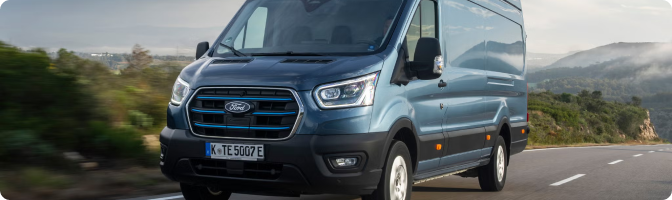
The 2026 Ford E-Transit® is the all-electric configuration of Ford's full-size Transit commercial van. It shares the Transit body platform but replaces the gas powertrain with a rear-mounted electric motor and an 89 kWh usable battery, runs single-speed transmission, and delivers rear-wheel drive only. Three body styles cover the range of fleet and upfit applications: the Cargo Van for trade work and parcel delivery; the Cutaway for service body, ambulance, and RV upfits; and the Chassis Cab for specialty bodies built from a bare cab.
Standard equipment across the lineup centers on SYNC® 4 with a 12-inch center display, the 8-inch digital cluster, and Ford Co-Pilot360®. New for 2026, the 5G modem, heated front seats, and Vapor Injection Heat Pump are also standard across all three body styles.
The E-Transit fits operations with predictable local routes, reliable home-base or shop charging, and an interest in moving cost-per-mile and tailpipe emissions in a different direction. Broader Ford EV research starts on the Ford EV Lineup page; the Ford Model Research page covers the broader Ford new-vehicle lineup.
What body styles are available for the 2026 Ford E-Transit?
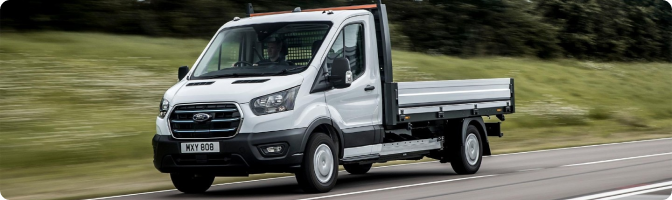
The E-Transit comes in three body styles, all built on the same all-electric T-350 SRW chassis with 9,500 pounds GVWR. Each body style serves a distinct upfit and operational profile.
| Body Style | Configurations | Max Payload | Best Fit |
|---|---|---|---|
| Cargo Van | 4 (Long Low/Medium/High Roof, Long-EL High Roof) | 4,063 lbs | Trade work, fleet delivery, parcel routes, mobile workshop |
| Cutaway | 2 (Long, Extended; 156"/178" wheelbase) | 4,201 lbs (Long) / 4,063 lbs (Extended) | Service body upfits, box trucks, ambulance, RV builds |
| Chassis Cab | 2 (Long, Extended; 156"/178" wheelbase) | 4,200 lbs (Long) / 4,025 lbs (Extended) | Maximum upfit flexibility for specialty bodies |
Cargo Van

The E-Transit Cargo Van is the standard van configuration with a finished body and rear cargo area. Available in Long and Long-EL (Extended) lengths and three roof heights (Low, Medium, High), with Long-EL only offered with High Roof. Cargo volume runs from 277.7 cubic feet behind the first row up to 487.2 cubic feet on the Long-EL High Roof. Maximum interior cargo height of 81.5 inches in the High Roof allows most adults to stand upright inside. The Cargo Van fits operations that load and unload through standard van rear and side doors, including parcel delivery, trade work, electrical and HVAC service, and mobile workshop applications.
Cutaway

The E-Transit Cutaway is a partially completed vehicle: it has a finished cab and chassis but no rear body, leaving the vehicle behind the cab open for upfit. Available in Long (156-inch wheelbase) and Extended (178-inch wheelbase). The Cutaway fits service body builds (utility-truck-style work bodies), box truck upfits, ambulance and emergency-services builds, and RV / camper van conversions. Maximum payload of 4,201 pounds on the Long configuration is the highest in the E-Transit lineup.
Chassis Cab

The E-Transit Chassis Cab is the most stripped configuration: a cab plus chassis with no body behind it at all, designed for upfitters who build specialty bodies from scratch. Available in Long (156-inch wheelbase) and Extended (178-inch wheelbase). The Chassis Cab fits the broadest range of specialty upfit applications where standard van or service body configurations don't fit the operation.
How does the E-Transit Cargo Van configure across roofs and lengths?
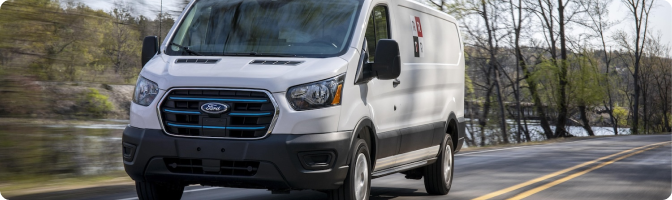
The Cargo Van offers four configurations across two body lengths and three roof heights. Long-EL is only available with the High Roof.
| Length | Roof | Cargo Volume Behind First Row | Max Cargo Volume |
|---|---|---|---|
| Long | Low | 277.7 cu ft | 311.9 cu ft |
| Long | Medium | 357.1 cu ft | 400.5 cu ft |
| Long | High | 404.3 cu ft | 453.4 cu ft |
| Long-EL | High | 487.2 cu ft | 536.4 cu ft |
Roof heights
| Roof | Max Interior Cargo Height | Best Fit |
|---|---|---|
| Low Roof | 56.9 in. | Garage parking, low overhangs, urban delivery |
| Medium Roof | 72 in. | Most commercial parking with added cargo height |
| High Roof | 81.5 in. | Standing room inside; regular load/unload work |
Body lengths
| Length | Cargo Length (at Floor) | Best Fit |
|---|---|---|
| Long | 143.7 in. | Standard commercial van footprint |
| Long-EL | 172.2 in. | Maximum interior space; volume-heavy operations |
The 50/50 hinged rear door with a 253-degree opening is standard on all High Roof Cargo Vans and optional on Low and Medium Roof. Side cargo door access, cargo tie-down hooks, fixed and foldable shelving, wall liner kits, and bulkhead options carry over from the gas Transit Cargo Van.
How does the E-Transit Cutaway and Chassis Cab configure?
The Cutaway and Chassis Cab share two wheelbase options, including the new-for-2026 156-inch wheelbase that supports a wider range of specialty upfits.
| Body Style | Length Variant | Wheelbase | Notes |
|---|---|---|---|
| Cutaway | Long | 156 in. | Overall length 241.1 in.; new 156" wheelbase for 2026 |
| Cutaway | Extended | 178 in. | Overall length 263.4 in. |
| Chassis Cab | Long | 156 in. | New 156" wheelbase for 2026 |
| Chassis Cab | Extended | 178 in. |
Both body styles are T-350 SRW configurations with 9,500-pound GVWR. The Cutaway includes a finished cab with the same SYNC 4 12-inch display, 8-inch cluster, and Co-Pilot360 standard equipment found on the Cargo Van. The Chassis Cab provides the cab and chassis only, with the area behind the cab left open for upfit. Vehicle Integration System 2.0 (the Ford Pro hardware-and-software platform that simplifies upfit electronic integration) is standard on both Cutaway and Chassis Cab; on the Cargo Van it's available.
What's the range, battery, and charging on the 2026 E-Transit?
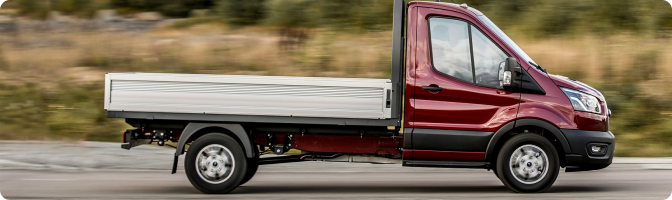
The E-Transit's powertrain is identical across all three body styles: a single rear-mounted electric motor, an 89 kWh usable lithium-ion battery, and a single-speed transmission. Rear-wheel drive only across the lineup; AWD is not offered on the E-Transit.
| Specification | Detail |
|---|---|
| Powertrain | Single rear-mounted electric motor, RWD |
| Power Output | 198 kW / 266 hp |
| Torque | 317 lb-ft |
| Battery | 89 kWh usable, high-voltage lithium-ion |
| Transmission | Single-speed |
| EPA-Estimated Range | Up to 159 miles |
| Top Speed | 75 mph (governed on Cargo Van) |
Charging access runs through North America's largest integrated public charging network, plus Level 1 (120V), Level 2 (240V), and DC fast charging at home-base or shop installations. The E-Transit charges from 10% to 80% in about 28 minutes on a DC fast charger and in about 8 hours on a Level 2 charger. A standard onboard charger handles Level 1 and Level 2 charging; an optional dual onboard battery charger doubles the maximum AC charging rate when paired with appropriate Level 2 infrastructure, reducing overnight charging time on fleet operations with high daily mileage. A Mobile Power Cord and Fast Charging Adapter (NACS) Bundle is also offered as an option for portable charging access.
The 159-mile range is the EPA estimate under standard test conditions. Real-world range varies with payload, ambient temperature, route profile, and driving behavior. For Southeast Michigan operations specifically, cold-weather range loss on EVs is a known concern. The 2026 E-Transit's new standard Vapor Injection Heat Pump is the lineup's specific answer to that concern (covered in the next section).
EV Charging InformationWhat's new for 2026 on the E-Transit?
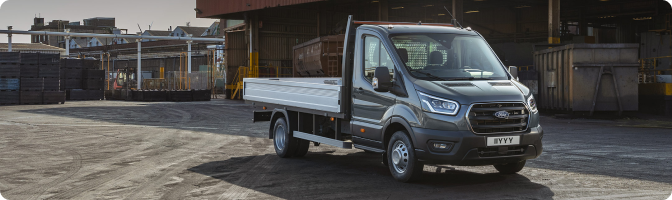
The 2026 model year brings five operationally significant updates to the E-Transit, headlined by the standard Vapor Injection Heat Pump.
| New for 2026 | What It Does |
|---|---|
| Vapor Injection Heat Pump (Standard) | Captures heat from outside air using a refrigerant cycle that draws far less battery energy than resistance heating; preserves cold-weather range |
| 5G Modem (Standard) | Replaces the prior 4G modem; faster connectivity and over-the-air update support |
| Heated Front Seats (Standard) | Standard on driver and passenger sides across the lineup |
| 156-inch Wheelbase Option | New shorter wheelbase configuration on Cutaway and Chassis Cab; broadens upfit flexibility |
| Dual Onboard Charger (Optional) | Doubles maximum AC charging rate when paired with Level 2 infrastructure |
The Vapor Injection Heat Pump (VIHP) is the most operationally meaningful of these for Southeast Michigan E-Transit fleets. The same technology runs on the Mustang Mach-E and F-150 Lightning. Traditional resistance heating in EVs draws substantial battery energy in cold weather, which is the primary reason EVs lose range on cold mornings. VIHP captures heat energy from outside air using a refrigerant cycle and uses that energy to heat the cabin and battery, drawing far less from the high-voltage battery than resistance heating. The result is better range retention in winter conditions, which directly affects how many miles an E-Transit operation can plan around per charge between November and March in the Detroit metro.
What does the 2026 E-Transit haul?
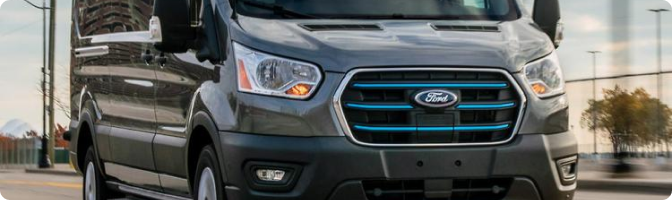
Maximum payload varies by body style and configuration, with the Cutaway Long delivering the lineup's highest figure at 4,201 pounds.
| Body Style | Configuration | Max Payload |
|---|---|---|
| Cargo Van | All configurations | Up to 4,063 lbs |
| Cutaway | Long (156" wheelbase) | 4,201 lbs |
| Cutaway | Extended (178" wheelbase) | 4,063 lbs |
| Chassis Cab | Long (156" wheelbase) | 4,200 lbs |
| Chassis Cab | Extended (178" wheelbase) | 4,025 lbs |
Final payload depends on installed packages, accessories, and upfit weight, and is confirmed via the door-jamb label at delivery. The E-Transit is not rated for towing; Ford does not publish a tow rating for the lineup, and the lineup is not configured with a factory tow package. Operations that need both electric efficiency on local routes and significant towing capacity are better served by a gas Transit Cargo Van or a different Ford commercial configuration.
What technology and safety features come with the 2026 E-Transit?
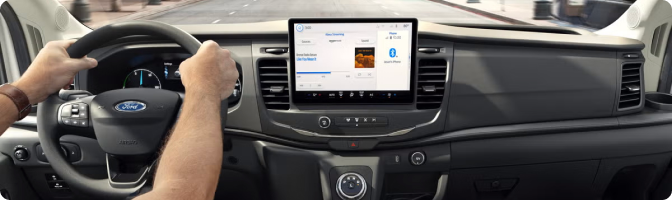
Standard tech on every 2026 E-Transit centers on SYNC® 4 with a 12-inch center touchscreen and a new 5G embedded modem with over-the-air update capability. Wireless Apple CarPlay® and Android Auto™ run through SYNC® 4. The 8-inch cluster display covers battery level, power gauge, range estimate, and trip data with customizable views (and is now standard rather than optional on prior model years). Telematics Essentials supports fleet management for organizational buyers tracking vehicle utilization, charge state, and route data. Push-button start with passive entry, AM/FM stereo with Bluetooth and dual USB ports, and the Ford Connectivity Package (one-year included) round out the cabin technology.
Ford Co-Pilot360® comes standard across the lineup and includes Lane-Keeping System, Pre-Collision Assist® with Automatic Emergency Braking, Post-Collision Braking, and a Rearview Camera Kit. Ford Co-Pilot360® Assist+ (on Cutaway and Chassis Cab) and Ford Co-Pilot360® Assist 2.0 (on Cargo Van) are available step-up packages that add Adaptive Cruise Control, Blind Spot Information System (BLIS®) with Cross Traffic Alert, and a 360-Degree Camera. A Digital Rearview Mirror is available across the lineup for buyers whose cargo or upfit equipment blocks the standard rearview mirror.
Vehicle Integration System 2.0 is standard on Cutaway and Chassis Cab and available on the Cargo Van. The Ford Pro hardware-and-software platform simplifies upfit electronic integration for fleet and trade applications, supporting third-party equipment like ambulance lights, refrigeration units, and fleet telematics installations. Pro Power Onboard™ is offered as an available 2.4 kW system, substantially larger than the gas Transit Cargo Van's 400 W system, drawing on the high-voltage battery to power tools and equipment off the vehicle.
Active safety equipment runs across the lineup. Occupant protection covers driver and passenger airbags plus Safety Canopy® side-curtain airbags. Anti-theft and post-incident response cover the SecuriLock® Passive Anti-Theft System with engine immobilizer, autolocking drive-away with crash unlocking, and the SOS Post-Crash Alert System™. Tire Pressure Monitoring System is standard. A Back Up Alarm is available.
Ford Driving TechnologyWhat does the 2026 Ford E-Transit cost in Clinton Township?

The 2026 E-Transit Chassis Cab and Cutaway open in the high-$40Ks for the base configurations. The Cargo Van starts in the low-$50Ks (Long Low Roof base configuration). Mid-tier Cargo Van configurations typically run in the mid-$50Ks. Loaded Cargo Van Long-EL High Roof configurations reach the high-$50Ks. Final pricing depends primarily on body style, length, roof height (Cargo Van), wheelbase (Cutaway and Chassis Cab), upfit packages, and any current Specials or eligibility programs. Destination charge applies on top of base MSRP.
The 2026 E-Transit may qualify for the federal Commercial Clean Vehicle Credit (Section 45W), which applies to qualifying electric and clean-energy commercial vehicles up to 14,000 pounds GVWR. The E-Transit's 9,500-pound GVWR puts it within that threshold. Whether 45W applies for any given purchase (and at what value) depends on the buyer's business structure, how the vehicle is used, and the federal program rules in effect for the tax year. Specific 45W eligibility is settled at the buying step. Lease and finance Specials are updated monthly at Dorian Ford.
Section 179 is the federal tax provision that lets qualifying business buyers deduct part or all of a commercial vehicle purchase in the year the vehicle is placed in service. Section 45W is the parallel federal credit specific to clean-energy commercial vehicles like the E-Transit. The two operate under separate rules; whether either applies, and how they layer with state programs and current Ford Specials, is settled with the buyer's tax structure in mind at the buying step. The Section 179 page covers how the deduction commonly applies to Ford commercial vehicles.
Section 179 Tax DeductionA/X/Z Plan pricing is offered through a Ford Motor Company program for eligible Ford employees, retirees, and partner-company employees, with qualification rules detailed on the A/X/Z Plan page. Commercial fleet buyers with a valid FIN code may have access to fleet-specific Ford programs depending on the size and structure of the purchase.
How do I buy or lease a 2026 E-Transit at Dorian Ford?

Three paths get a 2026 E-Transit into your operation: build a custom order to the exact configuration, browse current in-stock inventory, or test-drive a representative configuration before committing.
Pre-approval at Dorian Ford runs on a soft credit pull, which means no impact to your credit score before you've decided to buy. For E-Transit fleet buyers, pre-approval matters earlier in the process than on a gas vehicle because the financing structure often runs alongside parallel infrastructure decisions (Level 2 charger installation at the operating base, fleet management software setup, and potential utility-program coordination). Aligning the financing timeline with the operational rollout is more material on EVs than on gas commercial vehicles.
Get Pre-ApprovedThe configuration matrix on the E-Transit (three body styles, multiple wheelbases, four Cargo Van layouts, plus upfit packages) means almost every buyer custom-orders rather than picking from in-stock inventory. The Ford build tool puts together a custom order to the specific body style, length, roof height (Cargo Van), wheelbase (Cutaway and Chassis Cab), trade or upfit package combination, and optional charging equipment.
Custom Order ToolSchedule a test drive by appointment ahead of time. For an E-Transit, the test drive is where buyers feel what doesn't show up on the spec sheet: instant torque off the line, the cabin quiet at speed, regenerative braking pedal feel, and how the in-cluster range estimate behaves loaded versus unloaded. Driving a representative configuration before ordering matters more on EVs than on gas vehicles because the operational feel is genuinely different.
Schedule a Test DriveAn online instant estimate gets the trade evaluation started; the final number is settled in person at the dealership. Multi-vehicle trade scenarios are common when a commercial operation transitions a portion of a gas-engine fleet to E-Transit; those run through the trade-in step at the same time.
Trade-In ValueWhether to buy or lease an E-Transit usually comes down to total-cost-of-ownership math, and on an EV that math looks different than on a gas vehicle. Fuel cost is replaced by electricity cost (which is typically far lower per mile but depends on local utility rates and charging-time-of-use rates). Routine maintenance is reduced significantly because there's no oil change, fewer fluids, and no engine wear items. The high-voltage battery and electric components warranty runs longer than the bumper-to-bumper. The Buying vs. Leasing guide covers the trade-offs alongside gas Ford configurations. Ford Protect Extended Service Plans are offered for buyers planning to keep the van past the standard warranty.
Whether the E-Transit is the right answer for an operation comes down to route profile, daily mileage, and charging access. It works for operations with predictable local routes, reliable home-base or shop charging, and an interest in moving cost-per-mile and tailpipe emissions in a different direction. It doesn't work for everyone, and for plenty of trades the gas Transit Cargo Van remains the better answer. Dorian Ford's EV Specialist team works through the operational fit with commercial fleet buyers before configuration starts, including charging infrastructure questions that show up after delivery. The conversation is whether the E-Transit serves the work, not whether the buyer can be moved into one.
What else should I know about the 2026 Ford E-Transit?
The questions below cover details shoppers often want to confirm before scheduling a test drive or starting a custom order.
The 2026 E-Transit is offered in three body styles: Cargo Van (4 configurations across Long and Long-EL lengths with Low, Medium, and High Roof options); Cutaway (Long and Extended wheelbases on a finished-cab chassis for service body, ambulance, and RV upfits); and Chassis Cab (Long and Extended wheelbases on a cab-and-chassis configuration for the broadest range of specialty upfits).
The 2026 E-Transit has an EPA-estimated range of up to 159 miles on a full charge of the 89 kWh usable lithium-ion battery. Real-world range varies with payload, ambient temperature, route profile, and driving behavior. The new-for-2026 standard Vapor Injection Heat Pump is specifically designed to preserve cold-weather range by capturing outside heat for cabin warming using less battery energy than resistance heating.
The E-Transit charges from 10% to 80% in about 28 minutes on a DC fast charger and in about 8 hours on a Level 2 (240V) charger. An optional dual onboard battery charger doubles the maximum AC charging rate when paired with appropriate Level 2 infrastructure. The standard configuration handles Level 1 (120V) charging for emergency or low-utilization scenarios. Charging access runs through North America's largest integrated public charging network plus Level 2 and DC fast infrastructure at home-base or shop installations. EV Ownership FAQ covers charging questions in more detail.
The 2026 E-Transit is not factory-rated for towing. Ford does not publish a tow rating for the E-Transit and does not offer a factory tow package. Operations that need both electric efficiency and significant towing capacity are better served by a gas Transit Cargo Van with the available Heavy-Duty Trailer Tow Package (rated up to 6,900 pounds towing) or a different Ford commercial configuration.
Maximum payload reaches 4,201 pounds on the Cutaway Long configuration. Cargo Van maximum payload is up to 4,063 pounds across all four configurations. Chassis Cab payload is 4,200 pounds (Long) and 4,025 pounds (Extended). Cutaway Extended is 4,063 pounds. Final payload depends on installed packages and upfit weight, and is confirmed via the door-jamb label at delivery.
Five operationally significant updates: standard Vapor Injection Heat Pump (the headline cold-weather range improvement), 5G modem replacing 4G, standard heated front seats, a new 156-inch wheelbase option for Cutaway and Chassis Cab, and an optional dual onboard battery charger. The 12-inch SYNC 4 center display and 8-inch digital cluster are also standard for 2026 (they were optional on prior model years).
The 2026 E-Transit may qualify for the federal Commercial Clean Vehicle Credit (Section 45W), which applies to qualifying electric commercial vehicles up to 14,000 pounds GVWR. The E-Transit's 9,500-pound GVWR puts it within that threshold. Whether 45W applies for any given purchase, and at what credit value, depends on the buyer's business structure, vehicle use, and the federal program rules in effect for the tax year. Specific 45W eligibility and stacking with other federal and state programs is settled at the buying step.
Section 179 may allow qualifying business buyers to deduct part or all of an E-Transit purchase in the year the vehicle is placed in service rather than depreciating the cost over several years. Eligibility depends on the buyer's business structure, how the vehicle is used, and the federal program rules in effect. Section 179 and Section 45W are separate federal programs operating under different rules; both are settled with the buyer's tax structure in mind at the buying step.
The 2026 E-Transit is covered by a 3-year/36,000-mile bumper-to-bumper warranty, a 5-year/60,000-mile safety restraint system warranty, a 5-year/unlimited-mile corrosion (perforation only) warranty, a 5-year/60,000-mile roadside assistance program, and an 8-year/100,000-mile high-voltage battery and electric vehicle component warranty. Specific warranty terms are confirmed through Dorian Ford at the time of purchase.
The E-Transit and the gas Transit share the body platform and most cargo configurations but serve different operational profiles. The gas Transit offers the 3.5L PFDi V6 (275 hp) standard or the 3.5L EcoBoost® V6 (300 hp / 400 lb-ft) available, paired with a 10-speed automatic transmission and rear-wheel drive (Intelligent AWD available). It tows up to 6,900 pounds with the EcoBoost, supports T-150 through T-350 HD GVWR levels with payload up to 5,103 pounds, and runs on gasoline. The E-Transit offers a single electric motor (266 hp / 317 lb-ft), an 89 kWh battery with up to 159 miles range, a single-speed transmission, and rear-wheel drive only at T-350 SRW with 4,201-pound max payload. The gas Transit suits long routes, towing-intensive work, AWD-relevant operations, and high-mile delivery where range is unbounded. The E-Transit suits predictable local routes, fleet operations focused on cost-per-mile and emissions, and operations with reliable home-base charging infrastructure.
